Ordering and direct sales
Direct ordering channels can make ordering easier for guests while reducing unnecessary manual transfers inside the restaurant.
Robexa Restaurant Management System
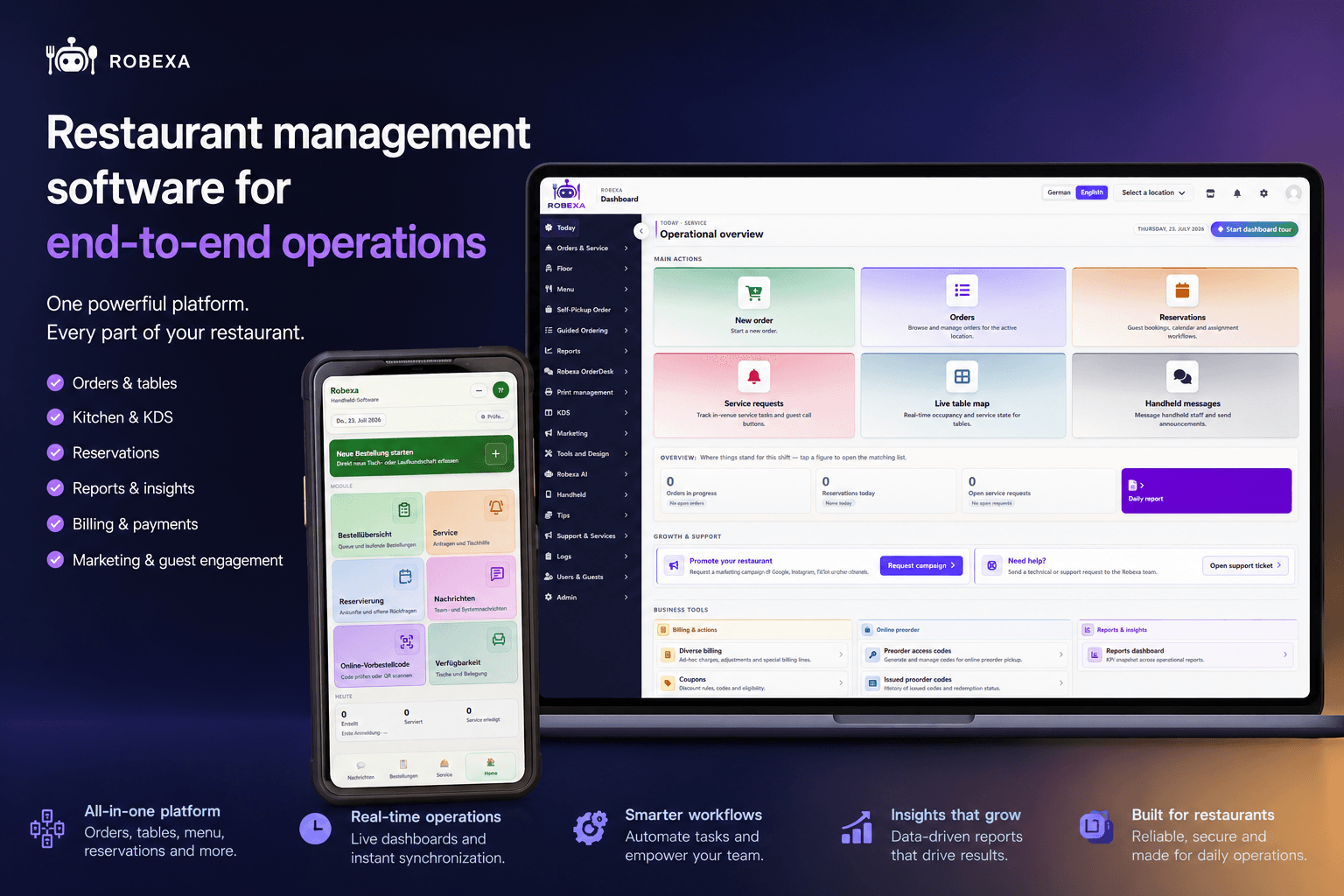
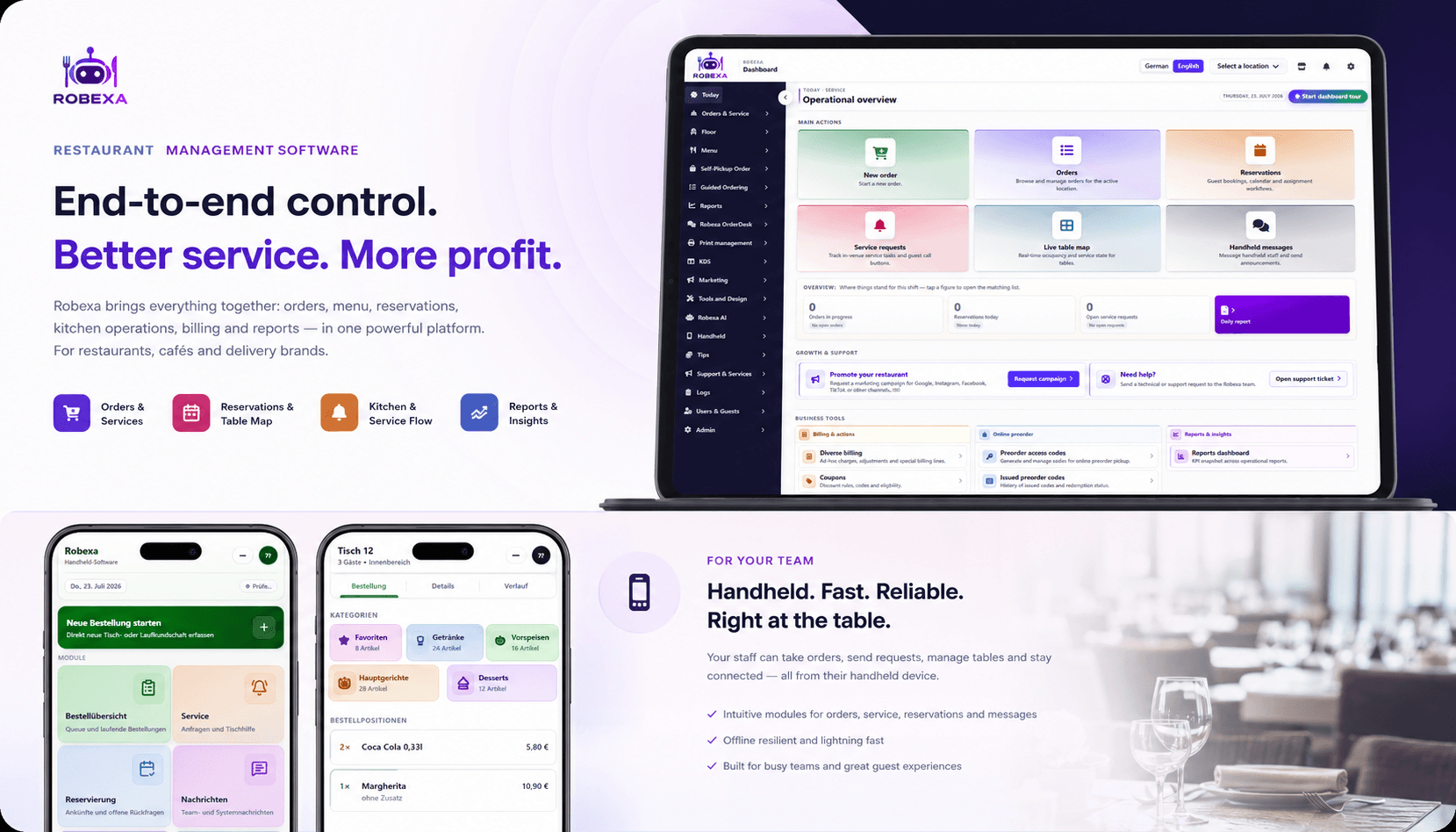
Robexa connects the workflows that meet every day in a restaurant: orders from different channels, table service, kitchen production, reservations, payments and management visibility. Start with the modules that address your most important operational bottleneck, then expand when the business needs more.
Modular rollout · Single or multi-location operations · Multilingual guest experiences
Less repeated data entry
Clearer handovers
Central operational visibility
Built to expand
Many restaurants already use digital tools. The menu may live in one system, reservations in another, while orders also arrive by phone, through the website or from external platforms. The kitchen may work with a mixture of printed tickets and screens, and managers still need to assemble information from several sources.
Each tool may work in isolation. The operational difficulty appears in the spaces between them: information is entered again, changes are not reflected everywhere, responsibilities become unclear and questions interrupt the team during service.
Peak periods reveal whether the restaurant is working through one connected process or whether employees are manually holding several disconnected systems together.
A restaurant management system brings the central workflows of a hospitality business into a connected platform. Guests, service staff, kitchen teams and managers do not necessarily use the same interface, but their work remains part of the same operational context.
An order may begin at a table, on the restaurant website, through WhatsApp, at a kiosk or with a member of staff. What matters is that it reaches the right working area with the right information and that its status remains understandable to the people responsible for the next step.
Robexa is not designed as a collection of unrelated features. Its modules support the stages of restaurant operation that depend on one another.
Depending on the restaurant concept, guests can order through a digital menu, a table QR code, the restaurant website, WhatsApp, a self-service kiosk or directly with a member of staff.
Products, options, table references, pickup or delivery details and relevant notes are captured in a structured form. The team spends less time interpreting free text or moving information between separate applications.
Orders can be routed to the kitchen, bar, printer zones or other workstations. Their status and operational ownership remain visible as they move through preparation.
Service staff see the tasks and order information relevant to their work. Depending on configuration, table workflows, pickup, order status and payment processes can operate as connected stages.
Managers gain a more consistent view of orders, activity and relevant performance information instead of assembling reports from disconnected sources.
Not every restaurant needs the same journey. Robexa is configured around the workflow that the operation actually uses.
Each Robexa module addresses a practical part of restaurant operations rather than existing as an isolated technical feature.
Direct ordering channels can make ordering easier for guests while reducing unnecessary manual transfers inside the restaurant.
The service team receives clearer information and can focus personal attention on guests who need advice, assistance or hospitality.
Orders can reach the appropriate preparation area with a clear status, helping kitchen, bar and fulfilment teams work from the same operational picture.
Reservations, arrival and table allocation can form one focused workflow without giving reception users access to ordering, payment or other unnecessary operational areas.
Payment and engagement capabilities can be added according to the restaurant’s operating model without making the entire platform dependent on one feature.
Managers can work from a more consistent operating picture and organise locations, modules and permissions around real responsibilities.
One operational picture
A connected platform does not mean that every employee sees the same screen. Kitchen, service, reception and management teams have different responsibilities and need different information.
Robexa can provide focused interfaces for these roles while keeping the underlying orders, status information and operational context connected.
Fewer disconnected information sources, clearer visibility of ongoing activity and a stronger basis for operational decisions.
Less unnecessary walking and repeated clarification, more visible order information and more time for advice and personal guest care.
Structured orders, clearer ownership and better visibility of new, active and completed work.
Reservations, arrivals, table status and seating within a focused interface that does not expose unrelated ordering or payment functions.
More ways to order, clearer information and less unnecessary waiting, without removing the option of personal service.
Because Robexa is modular, it can be configured for different operating models rather than forcing every restaurant into the same process.
Table service, reservations, handheld ordering, kitchen workflows, payments and management visibility can operate as connected parts of service.
Digital menus, QR ordering and straightforward repeat orders can help teams manage busy periods and large outdoor areas.
Direct web or WhatsApp orders can connect with preparation, collection and status communication.
Different ordering points, service areas and operating periods can be structured within one platform.
Locations can retain their operational workflows while configuration and management visibility become more centralised.
The appropriate module set depends on the service model, team, ordering channels and existing technology.
A restaurant does not need to replace its complete operation in one step. A practical Robexa rollout begins with the workflow that currently creates the most delay, errors or coordination effort.
01
Review how orders, information and responsibilities move through the restaurant today.
02
Choose the area where an improvement would be visible to the team and guests.
03
Configure the required capabilities, prepare content and train employees with realistic service situations.
04
Review what has changed after launch. Add further modules only where they provide a clear operational benefit.
The right restaurant software does not begin with the longest feature list. It begins with one process that should become noticeably better for guests and staff.
Success should not be measured by the number of active features. It should be visible in the way the restaurant operates.
Agree on the relevant indicators before implementation so that improvement can be evaluated against the restaurant’s actual priorities.
Restaurants differ widely. A small café does not operate in the same way as a full-service venue with several areas or a multi-location hospitality brand.
Robexa therefore does not assume that every business should use the same combination of functions. The platform provides a connected technical and operational foundation on which the relevant modules can work together.
The starting point is the restaurant’s operational bottleneck, not the length of the feature list.
Employees receive the interface and information required for their responsibilities.
Additional modules and workflows can be introduced as the operation requires them.
A restaurant management system connects central workflows such as ordering, service, kitchen operations, reservations, payments and reporting. Its purpose is to reduce isolated data and unnecessary manual transfers between teams.
No. Robexa is modular. A restaurant can begin with one clearly defined operational area and add other modules when they suit the concept and provide a practical benefit.
No. Individual restaurants, cafés, bars and delivery businesses can use selected modules. Multi-location capabilities are also available where central management and location-specific operation are required.
That is not the objective. Digital ordering and service tools should reduce unnecessary waiting and repetitive coordination. Personal advice and hospitality remain important whenever guests want or need them.
That depends on the existing technology, required integrations and agreed project scope. Technical and operational requirements are reviewed before implementation.
The process begins with a review of the current operation and its main bottleneck. Relevant modules are then configured, content is prepared, employees are trained and the new workflow is introduced in a controlled way.
Guest-facing interfaces and content can be provided in multiple languages depending on configuration. The required languages and content are defined during setup.
Implementation, staff enablement and ongoing support are planned according to the agreed operating model. The aim is for the team to use the workflow confidently during real service conditions.
See Robexa in your operation
In a tailored demo, we review your current ordering, service and kitchen processes and show which Robexa modules fit your operation.